

TRUNNANO Releases Comprehensive Selection Guide for Nine Advanced Ceramic Crucible Materials.
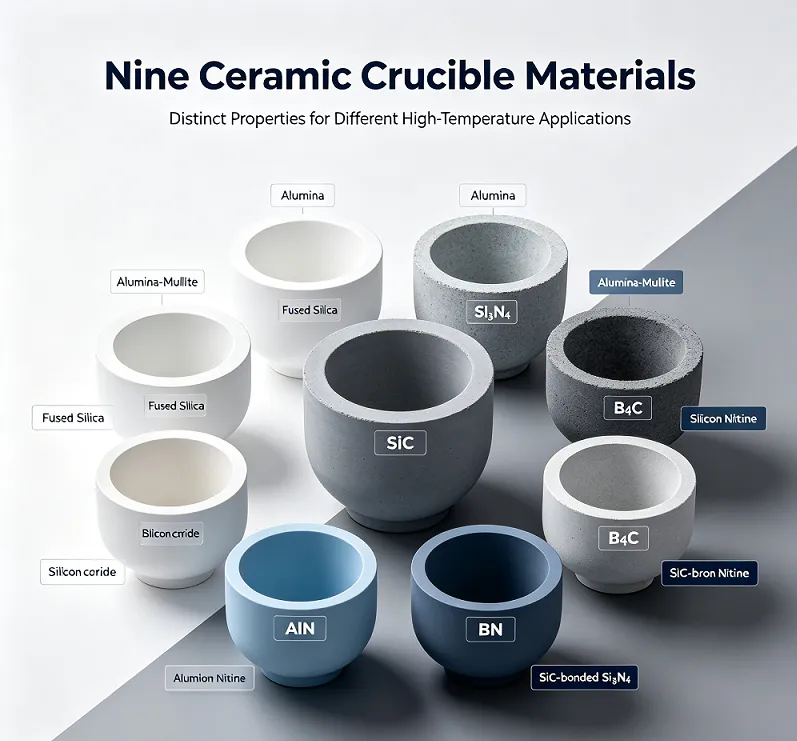
Nine ceramic crucibles from TRUNNANO
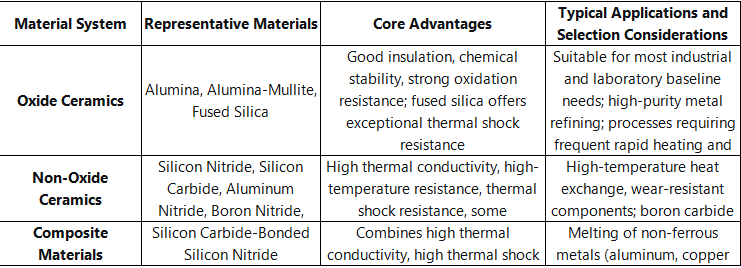
Comparison of Nine Material Systems for Advanced Ceramic Crucibles

TRUNNANO LOGO
TRUNNANO releases a guide on nine advanced ceramic crucibles, addressing processability and service life to optimize high-temperature industrial applications.
LUOYANG, CHINA, July 30, 2026 /EINPresswire.com/ -- TRUNNANO, through its advanced ceramics-focused website ozbo.com, has today released a comprehensive "Selection Guide for Advanced Ceramic Crucible Materials." The guide systematically addresses the processability, potential failure modes, and service life assessments of nine core ceramic crucible materials—aluminum nitride, alumina, boron carbide, boron nitride, fused silica, silicon carbide, silicon nitride, alumina-mullite, and silicon carbide-bonded silicon nitride—based on an in-depth analysis of current high-temperature industry demands. This initiative aims to provide engineers in metallurgy, semiconductors, new energy, and research fields with a scientific basis for material selection, resolving process bottlenecks and cost inefficiencies caused by improper material choices.
Precisely Addressing Material Selection Challenges in High-Temperature Processes
As processes in aerospace, specialty alloy smelting, and electronic material refining become increasingly demanding, the corrosive effects of molten metals and chemical environments on containment materials have intensified. Traditional single-material crucibles often fail to simultaneously meet the diverse requirements of thermal shock resistance, chemical inertness, high-temperature strength, and cost-effectiveness. Leveraging over 12 years of deep expertise in advanced ceramics, the TRUNNANO technical team has developed this systematic guide covering nine representative materials to address key industry pain points:
1. Oxide Ceramic Systems: Alumina, Alumina-Mullite, and Fused Silica
Alumina (Al₂O₃): As the most widely used engineering ceramic, alumina crucibles offer excellent comprehensive properties, high hardness, and good electrical insulation, making them the baseline material of choice for most industrial and laboratory applications. Its maximum service temperature can reach 1750°C, though limitations exist in scenarios requiring frequent thermal shock or high thermal conductivity.
Alumina-Mullite (3Al₂O₃·2SiO₂): This material combines the high-temperature performance of alumina with the exceptional creep resistance and thermal shock resistance of mullite. Its strength and toughness at 1300°C are approximately 1.7 times those at room temperature, making it ideal for high-temperature structural components and thermal protection applications.
Fused Silica (SiO₂): Renowned for its extremely low coefficient of thermal expansion and excellent thermal shock resistance, fused silica can withstand repeated cycling between 1000°C and cold water without cracking. It also exhibits chemical inertness toward many molten metals (such as Zn, Cd, Li, Na, etc.), making it suitable for high-purity metal refining and precision casting.
2. Non-Oxide Ceramic Systems: Silicon Nitride, Silicon Carbide, Aluminum Nitride, Boron Nitride, and Boron Carbide
Silicon Carbide (SiC): In process-dominated high-temperature environments, silicon carbide offers unparalleled advantages. Its thermal conductivity reaches 125.6 W/m·K, with a maximum air service temperature of up to 1900°C, combined with excellent wear resistance and chemical stability, making it a preferred choice for heat exchangers, furnace tubes, and metal melting crucibles.
Silicon Nitride (Si₃N₄): Known for its excellent thermal shock resistance, high fracture toughness, and oxidation resistance, silicon nitride outperforms many other ceramic materials in components that undergo frequent and drastic temperature changes.
Aluminum Nitride (AlN): With a thermal conductivity of 170–200 W/m·K, aluminum nitride is a core material for thermal management components. In crucible applications, its high thermal conductivity is utilized to enhance temperature field uniformity.
Boron Nitride (BN): Characterized by its unique machinability, boron nitride can be fabricated into complex shapes using conventional cutting tools. It is also non-wetting to most molten metals and serves as an excellent high-temperature electrical insulator, suitable for metal evaporation boats, insulating components, and thermocouple protection sheaths. Its primary limitation is significantly lower mechanical strength compared to structural ceramics.
Boron Carbide (B₄C): As the hardest material after diamond and cubic boron nitride, its unique neutron absorption cross-section makes it indispensable in nuclear industry shielding applications. However, its high cost and sintering difficulty limit its widespread use in general-purpose crucible applications.
3. Composite Material Systems: Silicon Carbide-Bonded Silicon Nitride
This composite material, produced through reaction bonding or recrystallization sintering processes, combines the high-temperature performance of silicon carbide with the thermal shock resistance of silicon nitride, resulting in crucibles that exhibit high thermal conductivity, high thermal shock resistance, high density, and excellent oxidation resistance. This material is particularly suitable for melting non-ferrous metals such as aluminum and copper alloys, offering significantly extended service life compared to traditional clay or graphite crucibles, with extremely low contamination of the melt.
Service Life and Failure Mode Management
The guide provides an in-depth discussion of the failure mechanisms for different crucible materials. For oxide-based crucibles (e.g., alumina), thermal shock cracking and melt penetration are the primary failure modes; for non-oxide materials (e.g., silicon carbide), chemical corrosion and oxidation are key considerations. Additionally, microstructural defects (such as pores introduced by additive manufacturing) can significantly reduce mechanical properties and dominate the failure process, requiring rigorous non-destructive testing for screening. By matching the correct material to the process, users can maximize crucible service life and optimize overall costs.
Mass Production and Application Prospects
Leveraging its advanced production capabilities, TRUNNANO can supply high-purity (e.g., 99.7% and above), high-density, precision-machined crucibles and custom components in all the aforementioned materials. The material systems covered in this guide have been widely adopted in core process areas including high-purity metal smelting, lithium-ion battery cathode material sintering, rare-earth permanent magnet material preparation, and semiconductor crystal growth, receiving positive feedback from customers.
Roger Luo, CEO of TRUNNANO, stated: "In high-temperature processes, a crucible is not merely a container—it is a critical factor determining product purity and process success. With this selection guide, we aim to systematize our years of application data and engineering experience across nine core ceramic materials, helping customers mitigate risks at the source and achieve cost reduction and efficiency improvement through scientific material selection. TRUNNANO and ozbo.com remain committed to driving technological innovation in advanced ceramic materials and providing the most professional material solutions to industrial customers worldwide."
About TRUNNANO and ozbo.com
TRUNNANO is a high-tech enterprise focused on the R&D, production, and sales of nanomaterials, advanced ceramic products, and high-purity chemicals. Its subsidiary website ozbo.com focuses on advanced ceramics, dedicated to providing global customers with high-quality full-category advanced ceramic products—including alumina, silicon nitride, and silicon carbide—along with professional technical services. Under the leadership of CEO Roger Luo, the company has earned the trust of customers worldwide through excellent product quality and continuous innovation, empowering industrial development through material breakthroughs.
Roger Luo
Luoyang Tongrun Nano Technology Co., Ltd.
188 3795 6556
email us here
Legal Disclaimer:
EIN Presswire provides this news content "as is" without warranty of any kind. We do not accept any responsibility or liability for the accuracy, content, images, videos, licenses, completeness, legality, or reliability of the information contained in this article. If you have any complaints or copyright issues related to this article, kindly contact the author above.
