

Your media and advertising news from the world
Provided by AGP
New Study: Electronic Cannabis Delivery Systems Show 99.7% Lower Screening Hazard Than Pre-Roll Combustion
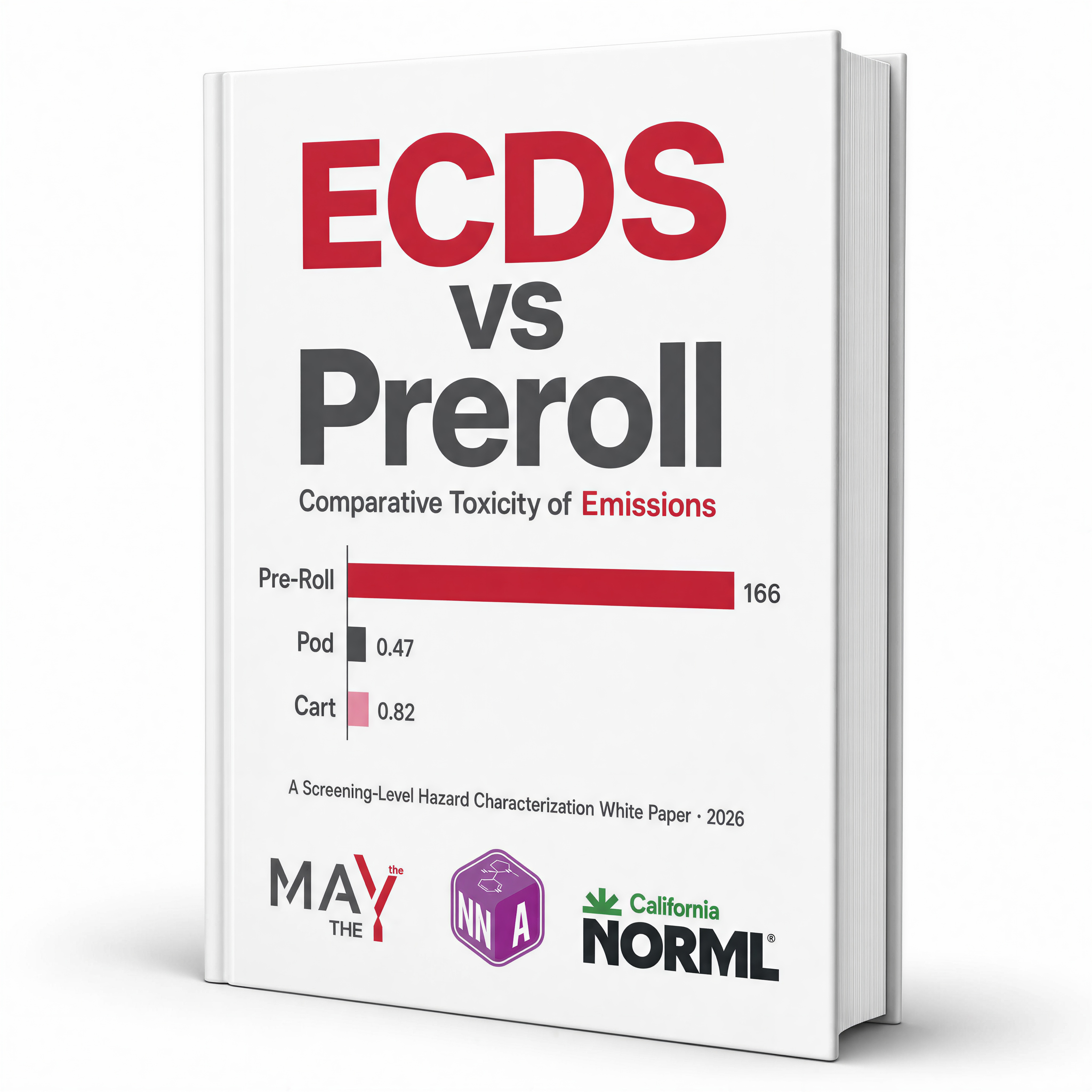
ECDS vs Preroll: Comparative Toxicity of Emissions

ECDSvsPreroll.com
First study to benchmark cannabis inhalation emissions against EPA chronic exposure finds ECDS produce 200–350× lower screening hazard than combustion.
The data doesn't call for panic; it calls for more research so regulators and legislators stop letting combustion set the benchmark for cannabis inhalation”
— Arnaud Dumas de Rauly
NEW YORK, NY, UNITED STATES, May 20, 2026 /EINPresswire.com/ -- A new independent study published today finds that smoking a cannabis joint produces a screening-level Hazard Index of 166 when benchmarked against U.S. Environmental Protection Agency (EPA) chronic inhalation standards, exceeding the conventional safety threshold by more than two orders of magnitude. By comparison, two electronic cannabis delivery systems tested in the same study produced Hazard Indices of 0.47 and 0.82, both below the screening benchmark of 1.
The research, conducted by MayThe5th Consulting, California NORML, and analytical laboratory NN Analytics, represents the first screening-level hazard characterization to directly compare cannabis combustion smoke against electronic cannabis delivery system (ECDS) emissions using the EPA's Reference Concentration for Inhalation (RfC) Chronic framework.
The dominant driver of the combustion hazard is acrolein, a reactive aldehyde produced when plant material and rolling paper burn. Acrolein alone exceeds its EPA chronic comparator by 165-fold under the study's modeled daily intake. In the electronic devices, acrolein was not detected.
The study also produced findings that challenge common assumptions about cannabis consumption. Pre-rolled joints delivered higher per-puff levels of both formaldehyde (a known carcinogen) and lead than the electronic alternatives. The electronic devices delivered more of the active ingredient - Δ9-THC - per puff than the joint, and preserved over 95% of the THC from the source oil through to the aerosol. The researchers introduced a new metric, the Cannabinoid Restitution Ratio, to quantify this: electronic devices scored 95–98% cannabinoid preservation versus just 10% for combustion.
"The dangers of vapes have been misrepresented by anti-smoking advocates to suggest their emissions are as hazardous as smoke. They are not," said Dale Gieringer, Ph.D., Director of California NORML and co-author of the study. "Hopefully, the government's recent rescheduling decision will end obsolete restrictions that have hindered researchers from studying cannabis vape pens that are readily available to millions of U.S. consumers."
The study did identify a residual concern with electronic devices: nickel and chromium, leached from heating element alloys used in some cartridge designs, represent the dominant remaining hazard pathway. The researchers characterize this as a solvable material selection problem rather than a fundamental design limitation.
"The data doesn't call for panic; it calls for immediate, results-driven technical optimization, but most of all, for more research so regulators and legislators stop letting combustion set the benchmark for cannabis inhalation," said Arnaud Dumas de Rauly, Founder of MayThe5th Consulting and co-author.
Jake Rubenstein, founder of NN Analytics and co-author said "This hazard index framework, anchoring cannabis emissions to EPA RfC comparator limits, is mission critical to any defensible comparison of ECDS to combustible products, and NN Analytics is committed to broadening the scope of this work."
The study used validated analytical methods (HPLC, GC/MS, ICP/MS) and a custom emissions sampling device, the Iron Lung v3, to collect and analyze aerosol from each product format in triplicate. Daily exposure was modeled at 22 puffs per day, based on published cannabis consumption topography data from a survey of 2,000 users.
The researchers note that this is a screening-level characterization, not a comprehensive toxicological risk assessment, and that additional more robust studies, including testing under abusive operating conditions and adding polycyclic aromatic hydrocarbon (PAH) measurements are recommended.
The complete white paper and data are available at ECDSvsPreroll.com.
About the Researchers:
https://MayThe5th.co/ - Strategic operations advisory, with a strong presence in vaping and cannabis industries. Founder Arnaud Dumas de Rauly chairs international standards committees (ISO TC126/SC3, CEN TC437).
https://www.canorml.org/ - A leading cannabis policy reform and consumer safety nonprofit, active since 1972. Director Dale Gieringer, Ph.D., is a nationally recognized authority on cannabis harm reduction.
https://www.NNanalytics.com/ - An analytical testing laboratory specializing in inhaled product emissions. Developer of the Iron Lung v3 validated sampling platform. Led by Jake Rubenstein.
Arnaud Dumas de Rauly
MayThe5th Consulting
arnaud@maythe5th.co
Legal Disclaimer:
EIN Presswire provides this news content "as is" without warranty of any kind. We do not accept any responsibility or liability for the accuracy, content, images, videos, licenses, completeness, legality, or reliability of the information contained in this article. If you have any complaints or copyright issues related to this article, kindly contact the author above.
