

Global Ferro Vanadium Market Outlook: Asia-Pacific Leads as Pangang Group, AMG Vanadium Drive Growth to 2035
Rising demand for high-strength steel alloys across construction, energy, and transportation sectors drives steady market expansion
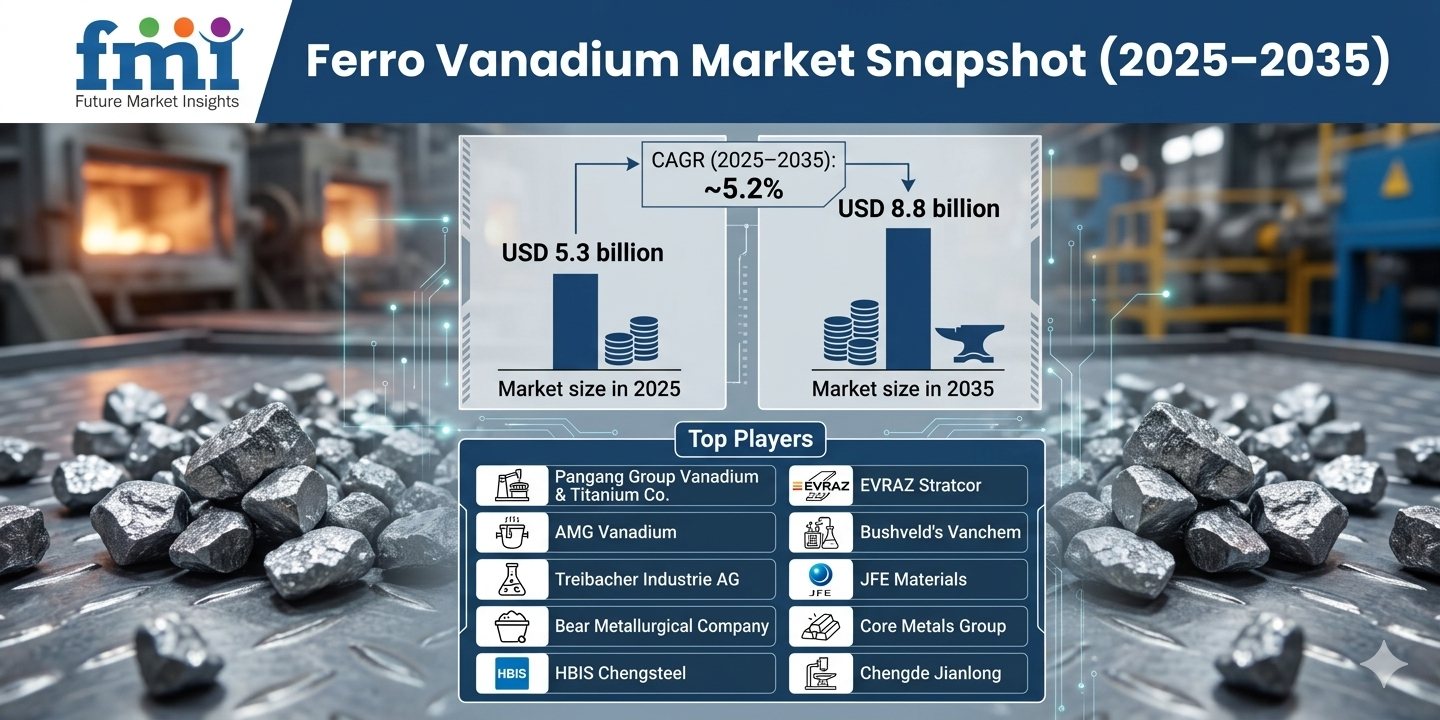
NEWARK, DE, UNITED STATES, March 26, 2026 /EINPresswire.com/ -- The global ferro vanadium market is valued at USD 5.3 billion in 2025 and is projected to reach USD 8.8 billion by 2035, expanding at a CAGR of 5.2% over the forecast period. Growth is supported by increasing steel production, widespread adoption of high-strength low-alloy (HSLA) steels, and sustained demand from construction, automotive, and energy industries where vanadium enhances tensile strength, fatigue resistance, and durability.
Ferro vanadium continues to play a critical role in microalloying processes, enabling the production of structural steel, reinforcing bars, pipelines, and advanced engineering components. As infrastructure development and energy transition investments accelerate globally, the need for high-performance steel materials is strengthening ferro vanadium’s strategic importance.
Ferro Vanadium Market Snapshot (2025–2035)
• Market size in 2025: USD 5.3 billion
• Market size in 2035: USD 8.8 billion
• CAGR (2025–2035): ~5.2%
• Leading grade: FeV 80
• Top end-use segment: Construction & rebar steel
• Key growth regions: Asia-Pacific, North America, Europe
• Core application: HSLA and structural steel manufacturing
Market Momentum
The ferro vanadium market begins its growth trajectory at USD 5.3 billion in 2025, supported by infrastructure expansion and steady steel demand. Between 2025 and 2030, the market grows to approximately USD 6.8 billion, driven by increasing adoption of high-grade FeV 80 alloys and improved metallurgical processes.
From 2030 onward, the market enters a more advanced phase, characterized by integration into energy infrastructure, aerospace-grade materials, and emerging energy storage technologies. By 2035, the market reaches USD 8.8 billion, reflecting stronger penetration across both traditional steel applications and new-age energy systems.
Request For Sample Report | Customize Report |purchase Full Report - https://www.futuremarketinsights.com/reports/sample/rep-gb-1487
Why the Market is Growing
The ferro vanadium market is expanding as global industries demand stronger, lighter, and more durable steel materials. In construction, stricter building codes and seismic safety standards are driving the use of vanadium-enhanced rebar and structural steel.
In the energy sector, ferro vanadium is essential for pipelines, pressure vessels, and offshore structures that require corrosion resistance and long operational life. Additionally, renewable energy infrastructure—such as wind turbine towers and solar installations—relies on high-strength materials for durability in harsh environments.
Another important growth factor is the rising interest in vanadium-based energy storage systems, particularly vanadium redox flow batteries (VRFBs), which are creating new demand avenues beyond traditional steel applications.
Segment Spotlight
1. End Use: Construction & Rebar Steel Dominates
Construction and rebar steel account for the largest share of demand, driven by mandatory high-strength standards and increasing adoption of earthquake-resistant construction materials.
2. Grade Type: FeV 80 Leads the Market
FeV 80 dominates due to its high vanadium content (typically 78–82%), enabling superior strength enhancement and compatibility with HSLA steel production.
3. Application: HSLA Steel Remains Core
High-strength low-alloy steel applications continue to lead, offering improved mechanical properties while maintaining cost efficiency in large-scale steel production.
Drivers, Opportunities, Trends, Challenges
Drivers:
• Rising demand for high-strength steel in infrastructure and construction
• Expansion of energy infrastructure and pipeline networks
• Growth in renewable energy projects and storage systems
Opportunities:
• Development of vanadium-based energy storage technologies
• Vertical integration of vanadium supply chains
• Advancements in aluminothermic reduction processes
Trends:
• Increasing preference for FeV 80 in high-spec applications
• Integration of ferro vanadium in energy and aerospace sectors
• Growing focus on recycling and resource efficiency
Challenges:
• Volatility in vanadium prices
• Competition from alternative alloying elements such as niobium
• Supply chain concentration in key producing regions
Regional Growth Outlook (2025–2035)
Asia-Pacific leads global growth, with China and India driving demand through large-scale infrastructure projects and strong steel production capacity. China remains the dominant market due to its integrated vanadium resources and aggressive construction standards.
North America shows steady expansion supported by infrastructure renewal programs, pipeline replacement, and defense manufacturing. Europe maintains consistent growth through high-quality engineering standards, automotive applications, and sustainable steel initiatives.
Competitive Landscape
The ferro vanadium market is moderately consolidated, with key players focusing on production stability, alloy consistency, and long-term supply agreements with steel manufacturers. Competition is centered on maintaining high vanadium content, reducing impurities, and ensuring reliable supply chains.
Market participants are increasingly investing in vertical integration strategies, including mining, processing, and recycling of vanadium, to enhance supply security and reduce cost volatility. Technological advancements in production processes and quality control systems are also becoming key differentiators.
Frequently Asked Questions (FAQ)
What is the global ferro vanadium market size?
The market is valued at USD 5.3 billion in 2025 and is projected to reach USD 8.8 billion by 2035.
What is the expected growth rate?
The market is expected to grow at a CAGR of approximately 5.2% during the forecast period.
What is ferro vanadium used for?
Ferro vanadium is primarily used as a strengthening agent in steel production, enhancing tensile strength, durability, and resistance to wear and fatigue.
Why is ferro vanadium important for modern industries?
It enables the production of high-performance steel required for construction, energy infrastructure, automotive components, and emerging energy storage systems, making it a critical material in industrial development.
Explore More Related Studies Published by FMI Research:
Hypersonic Testbed Additive Jet Blades Market https://www.futuremarketinsights.com/reports/hypersonic-testbed-additive-jet-blades-market
Sustainable Jet Fuel Microalgae Market https://www.futuremarketinsights.com/reports/sustainable-jet-fuel-microalgae-market
Solid-State Battery Precursor-Free Cathodes Market https://www.futuremarketinsights.com/reports/solid-state-battery-precursor-free-cathodes-market
About Future Market Insights (FMI)
Future Market Insights, Inc. (FMI) is an ESOMAR-certified, ISO 9001:2015 market research and consulting organization, trusted by Fortune 500 clients and global enterprises. With operations in the U.S., UK, India, and Dubai, FMI provides data-backed insights and strategic intelligence across 30+ industries and 1200 markets worldwide.
Why Choose FMI: https://www.futuremarketinsights.com/why-fmi
Sudip Saha
Future Market Insights Inc.
+1 347-918-3531
rahul.singh@futuremarketinsights.com
Legal Disclaimer:
EIN Presswire provides this news content "as is" without warranty of any kind. We do not accept any responsibility or liability for the accuracy, content, images, videos, licenses, completeness, legality, or reliability of the information contained in this article. If you have any complaints or copyright issues related to this article, kindly contact the author above.
